
Watercolor Dog Portraits: A Complete Guide
A watercolor dog portrait uses soft edges, bleeding color and white space, which makes it the most forgiving style for an imperfect photo. It is the usual choice for memorial portraits because it reads as gentle rather than stark. It suits light and medium coats better than very dark ones.

Of all the ways to turn a dog into art, watercolor is the gentlest. It softens edges, lets color bleed into open space, and leaves parts of the paper white and breathing. The result feels less like a photo and more like a memory. That soft, forgiving quality is exactly why the watercolor dog portrait has become the go-to style for memorials, senior dogs, and anyone who wants something tender rather than sharp.
This guide covers what defines the watercolor look, why it flatters so many dogs, how it rescues an imperfect photo, and how to make one of your own in minutes.
At a Glance
A watercolor dog portrait uses soft edges, bleeding color and white space, which makes it the most forgiving style for an imperfect photo. It is the usual choice for memorial portraits because it reads as gentle rather than stark, and it suits light and medium coats better than very dark ones.
| Portrait detail | What to know |
|---|---|
| The look | Soft edges, bleeding color, white space |
| Best for | Memorials, light and medium coats |
| Photo it needs | The most forgiving style of the set |
| Prints best as | Fine-art paper rather than canvas |
| Time to generate | About 30 seconds from one photo |
| Print-ready size | 12 × 16 in (30 × 40 cm) at 300 DPI |
What Makes a Watercolor Look Like Watercolor?
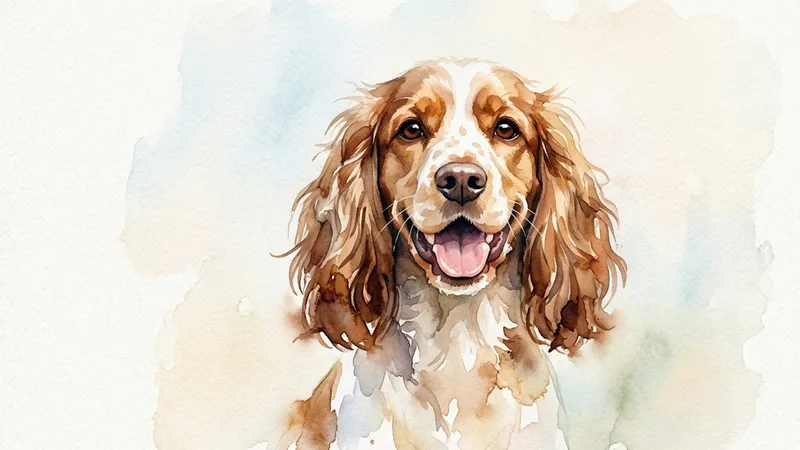
Four things make a portrait read as watercolor. Edges bleed rather than stop, so the dog dissolves into the background at the margins. Color pools and varies in density across a single area. White space is left as paper, not painted over. And the whole image looks quick — as if it were made in one sitting, wet on wet.
Soft edges. Watercolor rarely draws a hard outline. Fur fades into background, one color melts into the next, and the whole image feels a little dreamy. Nothing is clinical or cut-out.
Color bleed. Pigment spreads and pools the way real paint does on wet paper. You get gentle gradients and unexpected blooms of color that a photo never has.
White space. Much of the paper stays untouched. That empty space is part of the art, not a gap to fill. It gives the portrait air and keeps it feeling light.
Gentleness overall. Put those together and you get a soft, warm, emotional image. Watercolor doesn't shout. It's the quietest of the portrait styles, and that's the whole appeal.
Why Is Watercolor the Most Popular Style for Memorials?
Because it feels like remembering. A memorial portrait isn't trying to be a forensic record of a dog. It's trying to capture a feeling, and watercolor's soft, gentle character does that better than any other style.
The white space helps too. There's a stillness to a watercolor dog portrait that reads as peaceful rather than sad. It honors the dog without being heavy.
Senior dogs get the same benefit. A watercolor pet portrait flatters a graying muzzle or cloudy eyes, treating age as softness instead of decline. For a dog in their last chapter, it's a kind way to see them. Our pet memorial portraits guide goes deeper on working from older or imperfect photos.
Does Watercolor Forgive a Bad Photo?
Watercolor forgives a weak photo more than any other style, and that is one of its quiet strengths. Soft focus reads as intentional blur. Grain reads as paper texture. Mixed lighting reads as color variation. A photo that would produce a muddy oil portrait or a plainly wrong realistic one can still make a good watercolor.
Because the look is built on soft edges and loose color, it doesn't need a razor-sharp source. A slightly blurry snapshot, a photo with odd lighting, or an old print that has lost some detail all translate surprisingly well. The style smooths over exactly the flaws that would ruin a realistic rendering.
Forgiveness matters most for memorials, where the only photos you have might be years old and less than perfect. Where a realistic or oil style would expose every flaw, watercolor absorbs them. You still want a photo where the face is visible, but you don't need studio quality.
Better input still helps, of course. Our best dog photos for AI portraits guide covers how to give any style the strongest start.
Which Dogs and Coats Suit Watercolor Best?
Almost every dog suits watercolor, which is part of why the style is so popular, but a few types shine. Light and medium coats — cream, golden, tan, gray — gain the most, since the style builds color in translucent layers. Very dark coats gain the least, because watercolor has no way to render black without it going flat.
Fluffy and long-haired coats. Breeds with soft, flowing fur — a golden, a collie, a spaniel — are made for watercolor. The style renders that softness beautifully, letting the coat blend into the background.
Light and cream coats. Pale dogs work wonderfully because watercolor loves white space. A cream-colored dog can almost emerge from the paper itself.
Gentle-faced dogs. Any dog whose personality is sweet and calm suits the mood. The style matches their temperament.
Darker and short-haired dogs work fine too — they just carry a bit more contrast, which some people love. There's no coat watercolor truly fails on.
How Is Watercolor Different From Oil or Realistic?
Watercolor, oil and realistic styles aim at opposite feelings. Watercolor is light and gentle, and it lets the paper show. Oil is heavy and permanent, built up in opaque layers. Realistic aims at accuracy and reads closest to a photograph. Choose watercolor when you want softness rather than weight.
Oil is rich, textured, and dramatic. Deep colors, visible brushwork, a sense of weight and grandeur. Oil says heirloom and importance. Watercolor says tenderness and light.
Realistic is faithful and detailed — it tries to reproduce your exact dog, every whisker in place. It rewards a sharp photo and looks like a very good photograph turned painting.
Watercolor sits apart from both. It's not trying to impress you with detail or drama. It's trying to move you. Where oil fills the frame and realistic sharpens it, watercolor lets things go soft and leaves room to breathe. For a full side-by-side of every option, see our dog portrait styles explained guide.
If you want the opposite end of the spectrum, our royal Renaissance dog portraits guide covers the grand, dramatic look.
What Photo Works Best for a Watercolor Portrait?
A watercolor portrait needs a clear view of the face in soft light, and little else. The bar is lower than for any other style, but the eyes should still be visible and the head should fill a decent part of the frame. What watercolor cannot fix is a face in deep shadow or a dog shot from far away.
Show the face and eyes. Even a loose watercolor needs the eyes to land. If they're visible and reasonably in focus, the portrait will feel like your dog.
Prefer soft, even light. Overcast daylight or open shade suits the style's gentle mood and avoids harsh shadows that fight the soft look.
Fill the frame. Crop fairly close on the head and chest so there's enough of the face to work with.
Don't over-worry the rest. Odd background, slightly soft focus, an old photo — watercolor handles all of it. This is the style to reach for when your source isn't perfect.
Making Your Watercolor Dog Portrait
Once you have a photo, the portrait takes minutes. Upload it, choose the watercolor style, and you have a finished piece with our portrait generator — starting at a $1 trial.
The advantage of doing it yourself is trying variations. You might find one crop or one photo brings out your dog's gentleness better than another. Because each generation takes minutes and costs almost nothing, you can make several and keep the one that feels most like them.
Pricing is simple: a $1 trial to start, then $19.99 a month for unlimited portraits in every style, in HD. Cancel anytime. There are no per-photo fees — once you're in, you can make as many watercolor versions as you like.
Turning It Into Wall Art
A watercolor dog portrait is lovely on paper. A few popular ways people use one:
-
Framed print. Watercolor prints beautifully on textured or matte paper and suits a light, simple frame. Our printing and framing guide covers sizing and materials.
-
The memorial piece. A soft, peaceful portrait is a gentle way to keep a dog who has passed close by, without the weight a darker style can carry.
-
The gift. For a fellow dog lover, a custom watercolor dog art print of their own dog is about as personal as a gift gets.
The Gentlest Way to Turn Your Dog Into Art
Watercolor earns its popularity honestly. It flatters nearly every dog, forgives nearly every photo, and carries a tenderness the other styles can't quite reach. For a senior dog, a memorial, or simply a softer take on a dog you love, nothing else feels quite the same.
If you've got a photo — even an imperfect one — the hard part is done. Make your watercolor dog portrait here and see your dog rendered soft, warm, and gentle.
