
Husky Portraits: Turn Your Husky Into Art
A husky portrait works best in realistic or fantasy style, because both make the most of pale blue eyes and a wolfish coat — realistic for heterochromia, fantasy for drama. Light the white and gray evenly and get the eyes tack-sharp. One clear photo gives a portrait in about 30 seconds.

Few dogs look as dramatic as a husky. Those pale, ice-blue eyes seem to look straight through you. The face mask, the thick gray-and-white coat, the wolfish set of the ears — a husky already looks like a painting before you even start. That's exactly why a husky portrait tends to come out looking bold and cinematic rather than cute.
This guide is about capturing that drama. Which styles show off those striking eyes, how to photograph the tricky white-and-gray coat, and how to turn a good photo into art worth framing.
Husky Portraits at a Glance
A husky portrait works best in realistic or fantasy style, because both make the most of pale blue eyes and a wolfish coat — realistic for heterochromia, fantasy for drama. The white-and-gray coat needs even light to keep detail, and the eyes need to be tack-sharp. Generating takes about 30 seconds.
| Portrait detail | What to know |
|---|---|
| Best styles | Realistic, fantasy |
| Hardest part to photograph | White and gray fur needs even light to keep detail |
| Best crop | Tight on the face, eyes tack-sharp |
| Time to generate | About 30 seconds from one photo |
| Print-ready size | 12 × 16 in (30 × 40 cm) at 300 DPI |
What Makes a Husky Portrait So Striking?
A husky portrait is striking because of the eyes, and everything else follows from them. Huskies often have pale blue or ice-white eyes, and plenty are heterochromic — one blue eye, one brown. Around that sits the dark facial mask, which frames the eyes the way eyeliner does and gives the breed its intensity at any size.
Huskies often have pale blue or ice-white eyes, and plenty are heterochromic — one blue eye, one brown. That's rare in the dog world, and it reads as almost supernatural in a portrait. A good husky portrait treats the eyes as the star and builds the whole image around them.
Then there's the mask. The dark markings around the face frame those eyes like eyeliner, giving huskies their signature intense expression. Get the mask and the eyes both sharp, and you've captured the dog.
The coat does the rest. Thick, layered, gray-and-white, it gives an artist rich tones and a wolfish, wild look no other breed quite matches.
Put those three things together and you have a face that already looks composed and deliberate. Most breeds need a style to add drama. A husky brings its own, so the job of a good husky portrait is mostly to get out of the way and let the dog carry it.
Which Styles Suit a Husky Best?
Realistic and fantasy styles suit a husky best, because both lean into the breed's intensity rather than softening it. Realistic is the right call for a heterochromic dog, since the whole point is the exact eye colors. Fantasy suits the wolfish build — mist, snow, dramatic light. Watercolor is the weakest match, because soft edges wash out the mask. Here's how the main options land.
Realistic
The strongest match for the eyes. A clean, faithful rendering captures the exact pale shade and the light catching in them — which is the whole point with this breed. If your husky is heterochromic, realistic style is the one that shows off that one-blue-one-brown look best. Best when your source photo is sharp and well-lit.
Oil Painting
Depth and richness. Oil-painting style makes the thick coat look layered and dimensional, and the brushwork gives those pale eyes a luminous, almost glowing quality. If you want one husky portrait that looks like a serious commissioned piece, this is it.
Fantasy / Dramatic
Huskies are basically born for this. Their wolfish look sits perfectly against moody, cinematic backgrounds — mist, snow, dramatic light. This is where the wild side of the breed really comes through, and it suits a husky better than almost any other dog.
Royal / Renaissance
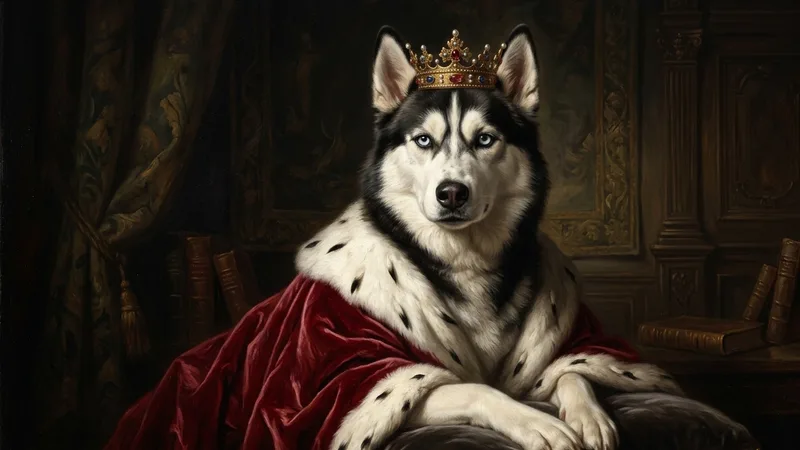
Surprisingly regal. A husky in ermine and velvet looks noble rather than silly — those piercing eyes carry real authority. If you like the idea, our royal and Renaissance portrait guide goes deeper on the look.
Watercolor
Softer, but it still works. Watercolor tones down the intensity into something gentle and sentimental, which suits an older husky or a lighter mood. It also forgives a lot in an imperfect source photo. Just know you trade some of the wolfish edge for warmth.
For a full side-by-side of every style, see our dog portrait styles guide.
How Do You Photograph a Husky's Coat and Eyes?
Photographing a husky means balancing a two-tone coat and pale eyes in the same frame. Shoot in soft, even light — overcast daylight or open shade — so the white sections keep detail instead of clipping and the gray does not go muddy. Focus on the eyes and keep them tack-sharp; a husky portrait with soft eyes has nothing left.
Nail the eyes first. Focus on the eyes and get them tack-sharp. A husky's whole expression lives there, and if they're soft or dull, the portrait falls flat no matter how good the coat looks.
Light the coat carefully. A husky's white sections blow out to featureless white in harsh sun, while the gray can go flat and muddy in dim rooms. Soft, even light — overcast daylight or open shade — keeps detail in both the white and the gray.
Avoid harsh backlight. Light from behind turns a husky into a glowing outline with a dark, lost face. You want light from the front or side so the mask, the eyes, and the coat texture all come through.
Fill the frame. Crop close on the head and chest. The more of the frame your husky's face takes up, the more detail there is to turn into a portrait — especially in those eyes. Our best photos for AI portraits guide and the dog photography tips piece cover this in detail.
Shoot at eye level. Kneel down and meet your husky where they are. A photo taken from above shrinks the eyes and flattens the mask; one taken at eye level keeps that direct, confident stare that makes the breed so photogenic in the first place.
Catch a still moment. Huskies rarely sit still, but you only need one frame. Wait for a pause — after a run, or when something catches their attention — and fire off several shots. One of them will have the alert, level expression you want.
How Do You Actually Make One?
Once you have a good photo, the portrait itself is fast. Upload the photo, choose a style, and you have a finished piece in minutes with our portrait generator — starting at a $1 trial.
The real advantage of doing it yourself is trying combinations. A husky looks incredible in realistic style, but you might find the fantasy version captures your dog's wild side better, or that the oil treatment makes those eyes glow in a way you didn't expect. Because each one takes minutes and costs almost nothing, you can make several and choose.
What Does It Cost?
Simple and flat. It's a $1 trial to start, then $19.99 a month for unlimited portraits — every style, as many versions as you want. Cancel anytime. There are no per-photo fees, so experimenting with five styles costs the same as making one.
What Do People Do With Husky Portraits?
Husky portraits mostly end up on walls, and the reason is presence — those eyes pull focus from across a room. A 16 × 20 in (40 × 50 cm) canvas suits the breed. Smaller prints work as gifts for the dog's people, and the fantasy versions are popular as avatars.
A dramatic or oil-style husky portrait, printed on canvas, looks like a genuine art piece rather than a pet photo. It also makes a reliable gift for the husky owner in your life — husky people are devoted, and they rarely have anything that does their dog justice.
The Most Cinematic Dog, Made Into Art
Huskies were made for this. That mask, that thick wild coat, and above all those pale, piercing eyes give you more drama to work with than almost any other breed — and it shows in the finished piece.
If you've got a husky and a decent photo, the hard part is already done. Make your husky portrait here — try it in realistic and fantasy both, and see which one captures the dog you know.
